


Concrete in compression
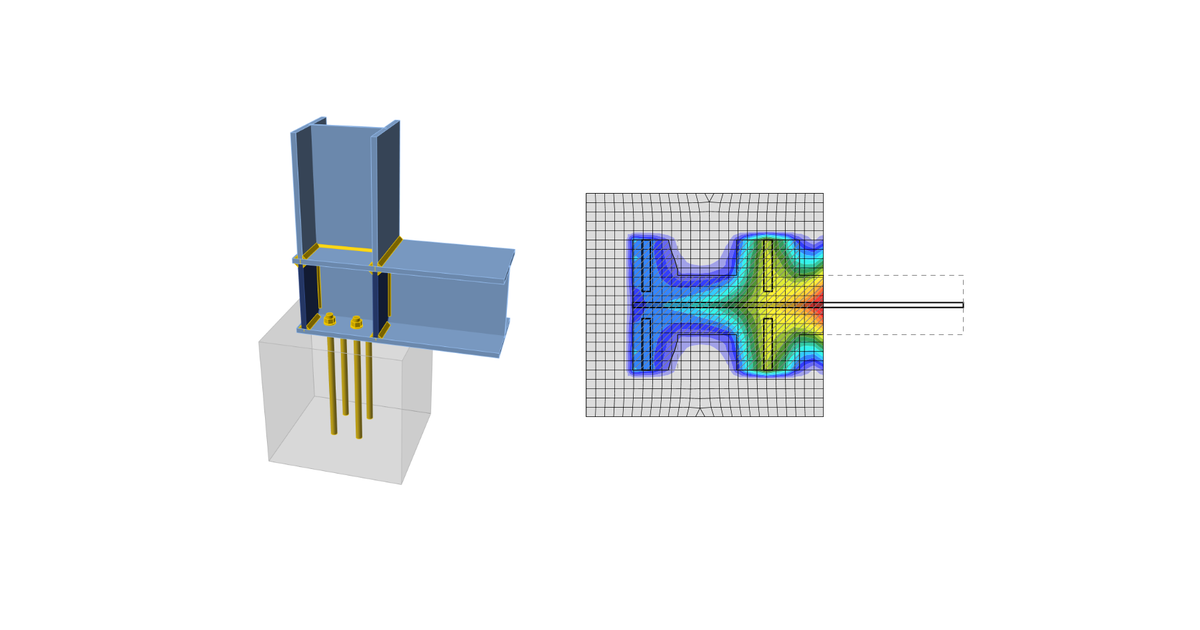
Concrete in compression under the base plate is checked according to SP 63.13330.2012, Cl. 8.1.44 – Calculation of reinforced concrete elements for local compression:
where:
- N – local compressive force from an external load
- ψ – factor equal to 0.75 in case of non-uniform distribution of the local load across the bearing surface
- Rb,loc = φb Rb – design compressive resistance of concrete in case of the local impact of compressive force
- and 1.0 ≤ φb ≤ 2.5 – concentration factor taking into account the triaxial stress in concrete
- Rb = Rbn / γb – design value of concrete axial compressive resistance
- Rbn – normative axial compressive resistance of concrete
- γb = 1.3 – reliability factor for concrete under compression; editable in Code setup
- Ab,loc – application area of the compressive force (bearing area surface) determined by finite element method as area in contact between the base plate and concrete block
- Ab,max – maximum design area established based on the following rules:
- gravity centres of areas Ab,loc and Ab,max coincide
- maximum design area is geometrically similar to the application area; the slopes are 1 vertical to 2 horizontal.
Transfer of shear
The shear action at the base plate is assumed to be transferred from the column to the concrete foundation by:
- Friction between base plate and concrete / grout
- Shear lug
- Anchor bolts
Anchors
The tensile forces in anchors include prying forces and are determined by finite element analysis.
Anchors are not checked in the software.